

How AI Is Impacting Cyberattacks and Cybersecurity Worldwide
AI is making cyberattacks faster, more sophisticated and easier to scale. But it is also giving security teams new ways to detect threats, investigate suspicious activity, and protect critical systems.
Imagine being unable to access your bank account, complete an online payment, or collect your passport because an essential digital service has stopped working.
These disruptions may have different causes, but they highlight the same problem: our growing dependence on connected digital systems. When one critical service fails, the consequences can extend far beyond the organization itself.
As artificial intelligence becomes more accessible, cybercriminals are finding new ways to automate attacks, create convincing scams and exploit security weaknesses. At the same time, businesses are turning to AI to strengthen threat detection and respond faster.
The question is no longer whether AI will change cybersecurity. It is whether organizations can keep their defenses ahead of the threats.
Three Incidents, One Global Lesson
Recent incidents across different countries show how disruptions to essential digital services can affect customers, businesses, and public infrastructure. Although these incidents were not all caused by cyberattacks, they highlight why digital resilience matters.
Paraguay (November 2026): Digital lender Ueno Bank was put into resolution by regulators as it had less than half the required capital. This impacted nearly 3 million customers and although there was no cyberattack identified, it caused a financial and governance issue. It shows how having a single point of entry for everyday financial transactions can leave you open to risk.

Netherlands (May 2026): Payment provider Mollie suffered frequent issues with ABN AMRO iDEAL. This caused concern that customers may be unable to complete their purchase.

Australia (November 2025): Passport processing was halted nationwide, causing staff to manually process travel documents. This caused long queues at Sydney and Melbourne airports. Officials stated that this was due to a technical issue.

These incidents had different causes, but they share an important lesson: when people and businesses depend on interconnected digital services, even a single disruption can have widespread consequences.
How AI is making Cyberattacks faster and more sophisticated
As cybercrime becomes increasingly automated, AI can be used to make fake accounts appear realistic, find vulnerabilities in software, and carry out multiple tasks to penetrate a system. In September 2026, Anthropic highlighted how they had disrupted an AI enabled espionage attack that targeted around 50 organizations.
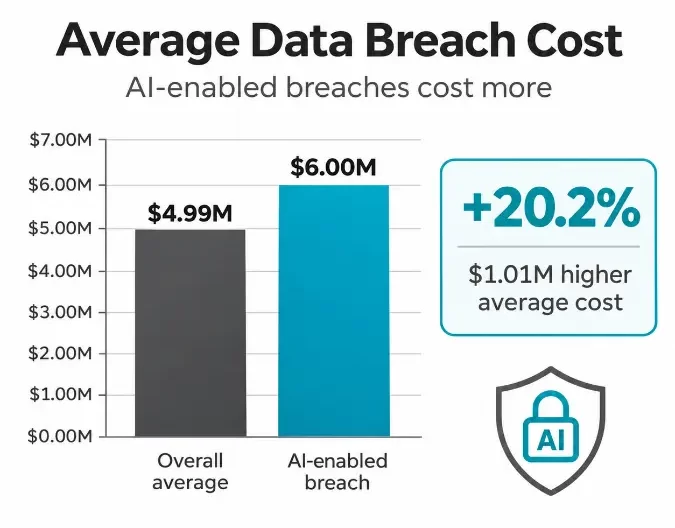
IBM’s 2026 Cost of a Data Breach research shows that 1 in 4 malicious breaches are AI-enabled, and the average cost is $6 million compared to $4.99 million overall. CrowdStrike has also seen an 89% increase in attacks from AI-enabled adversaries.
The risks don’t stop at IT
Cybersecurity is no longer just an IT concern. It is a business continuity and customer trust issue.
Disruption can cause problems for banks to pay employees, save and pay bills. Retailers can suffer as checkouts fail to work, plus with AI enabled fake accounts there is increased risk of customers requesting refunds and fraud.
Airlines and public services will suffer from systems being unavailable causing long queues. Customers can be scammed through deepfake calls and realistic payment scams.
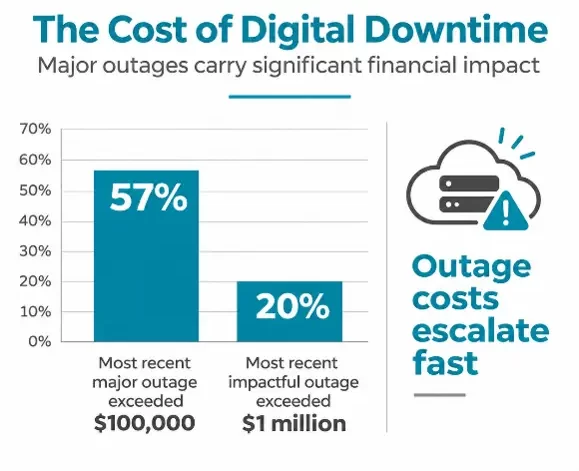
Uptime Institute’s 2025 survey shows that 57% of respondents said that their last major outage cost them over $100,000. Visa have identified nearly $1 billion of scam related activity in just 6 months of 2025.
Can AI help defend against Cyberattacks?
AI can be used to identify anomalous transactions, prioritize vulnerabilities and speed up investigations.
IBM found that organizations which have implemented highly AI enabled security measures and automation, have an average breach cost of $1.93 million less.
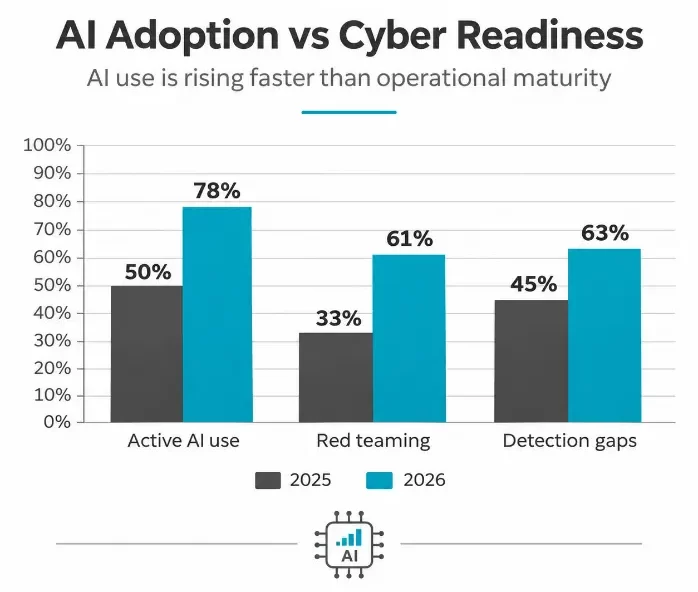
However, SANS found that 78% of security practitioners’ organizations were currently using AI. However, 63% said they had major issues with AI detection and responses.
The Race is on for Cyber Resilience
The UK’s National Cyber Security Centre expects AI to contribute to more sophisticated and large-scale cyber threats, increasing the pressure on organizations responsible for critical infrastructure.
Preparing for this changing threat landscape requires more than investing in new security tools. Businesses need stronger identity verification, secure AI implementation, appropriate human oversight, and tested incident recovery plans.
Maintaining alternative service providers and manual processes can also help organizations continue operating when critical systems fail.
AI may accelerate both cyberattacks and cyber defenses. But when disruption occurs, an organization’s resilience will determine how quickly it can recover.
Frequently Asked Questions (FAQs)
- Can AI-powered cyberattacks bypass traditional security systems?
Yes. AI can help attackers identify vulnerabilities, develop sophisticated phishing campaigns, and adapt their techniques to evade traditional security controls. Organizations increasingly need behavioural monitoring, continuous threat detection, and layered security to counter evolving threats. - What is adversarial AI, and why is it a cybersecurity concern?
Adversarial AI involves manipulating AI systems to produce incorrect or unsafe outcomes. Attackers may use techniques such as data poisoning, prompt injection, or adversarial inputs to deceive AI-powered security tools, potentially weakening automated detection and decision-making. - How can individuals recognize AI-generated phishing and deepfake scams?
AI-generated scams can imitate familiar voices, faces, and writing styles. Warning signs include unexpected requests for money, urgent demands, suspicious links, and requests for sensitive information. Independently verifying requests through trusted contact channels remains one of the most effective precautions. - Will AI eventually replace human cybersecurity professionals?
AI is more likely to transform cybersecurity roles than eliminate them. While automation can handle repetitive monitoring, threat analysis, and initial incident triage, human expertise remains essential for complex investigations, strategic decisions, ethical oversight, and responding to unfamiliar threats.
Data Sources
- Banco Central del Paraguay
- Reuters
- Mollie
- ABC News
- Anthropic
- IBM
- CrowdStrike
- SANS
- Verizon
- UK NCSC
- Visa
- Uptime Institute
The future of cybersecurity is changing rapidly. For further research into this topic, emerging trends in technology, and data-driven business insights, get in touch with Innovius Research.
Other Market Insights