

Elon Musk vs Ambani? The Starlink India License Row Explained
Starlink has a license, but it hasn’t launched commercially. Is India’s satellite internet delay about competition, regulation or security?
Elon Musk’s Starlink India launch has sparked a fresh controversy. On 8 October 2026, Musk accused “certain oligarchs” of blocking Starlink to protect their market dominance. He later questioned Mukesh Ambani’s influence, asking, “Is Ambani the real boss of India?”
The Indian government rejected the discrimination allegations, insisting its satellite telecom approval process is fair and security-driven.
Licensed, But Still Grounded
Starlink, Jio Satellite and Eutelsat OneWeb have secured telecom licences. However, all three face security assessments before spectrum can be assigned and commercial operations can begin.
Starlink says it has built 20+ gateway sites and established India-specific data controls. Yet infrastructure readiness does not guarantee regulatory clearance.
Jio vs Starlink: Rivals or Partners?
The tension is not new. Jio previously favoured auctioning satellite spectrum, while Starlink supported administrative allocation. India ultimately chose administrative allocation.
Interestingly, Jio and Airtel signed Starlink distribution agreements in 2025, while pursuing competing satellite services.
Deloitte projects India’s satellite broadband market could reach $1.9 billion by 2030.
India’s Internet Divide: The Bigger Opportunity
India recorded 1.09 billion internet subscriptions in March 2026, yet 11,256 villages reportedly lacked 4G coverage as of May.
| Geography | Internet subscriptions | Per 100 people |
|---|---|---|
| Rural India | 440.87 million | 48.31 |
| Urban India | 651.93 million | 126.80 |
| Total | 1,092.79 million | 76.59 |
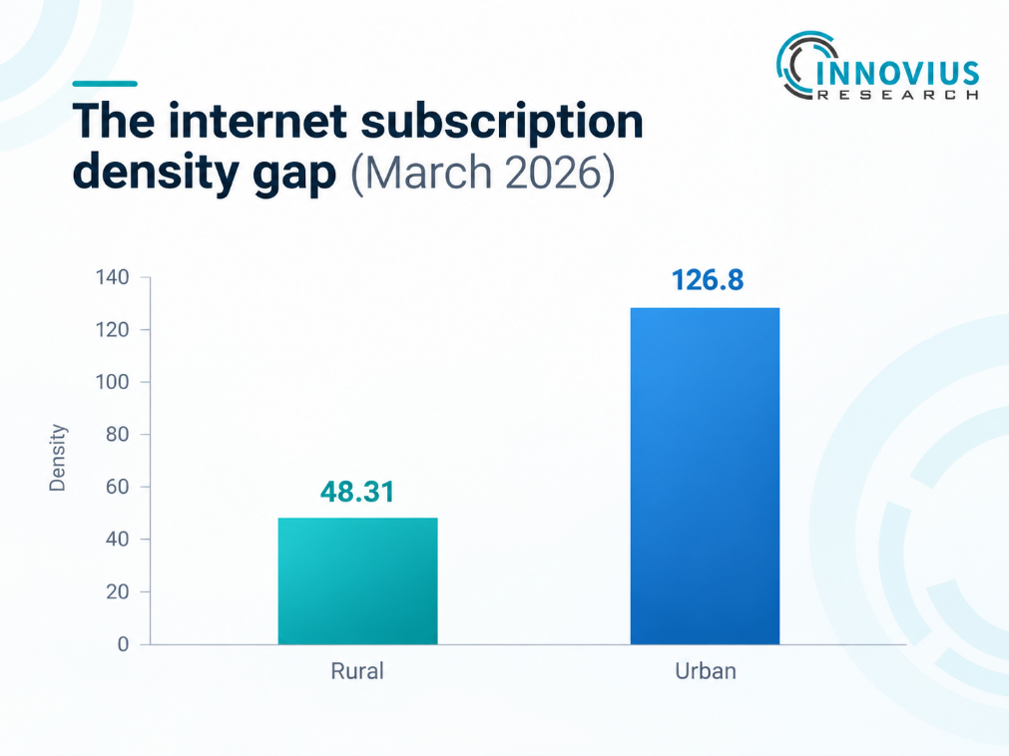
No. of total internet subscribers per 100 population
Who Wins If Starlink Launches?
Satellite broadband could improve connectivity for rural merchants, digital payments, schools, healthcare and remote businesses where traditional infrastructure is difficult to deploy.
But affordability remains crucial. However, equipment costs, subscription tariffs, service reliability and security requirements could limit adoption. Indian commercial pricing remains unconfirmed.
However, the real question is no longer just Musk versus Ambani. It is whether India’s satellite internet competition can deliver affordable connectivity to the people who need it most.
Data Sources: Reuters, Press Information Bureau (PIB), Government of India, Telecom Regulatory Authority of India (TRAI), The Indian Express, Hindustan Times, Reliance Industries, and others
Frequently Asked Questions (FAQs)
➤ What is Starlink?
Starlink is a satellite-based internet service developed by Elon Musk’s SpaceX. It uses a network of low-Earth-orbit (LEO) satellites to deliver high-speed broadband, particularly in rural and remote areas where traditional internet infrastructure is limited.
➤ Has Starlink received approval to operate in India?
Starlink has received its satellite telecom licence. However, as of October 2026, final security clearance and spectrum assignment remain pending before commercial operations can begin.
➤ Will Starlink compete with Reliance Jio and Airtel?
Yes. Starlink could compete with Jio and Airtel in satellite broadband. Interestingly, both Indian telecom operators also signed distribution agreements with Starlink in 2025, making them potential partners and competitors.
➤ How will Starlink benefit Indian consumers and businesses?
Starlink could improve internet access in rural and remote areas, supporting digital payments, education, healthcare and small businesses. However, its affordability and widespread adoption will depend on equipment costs, subscription pricing and service reliability.
Other Market Insights